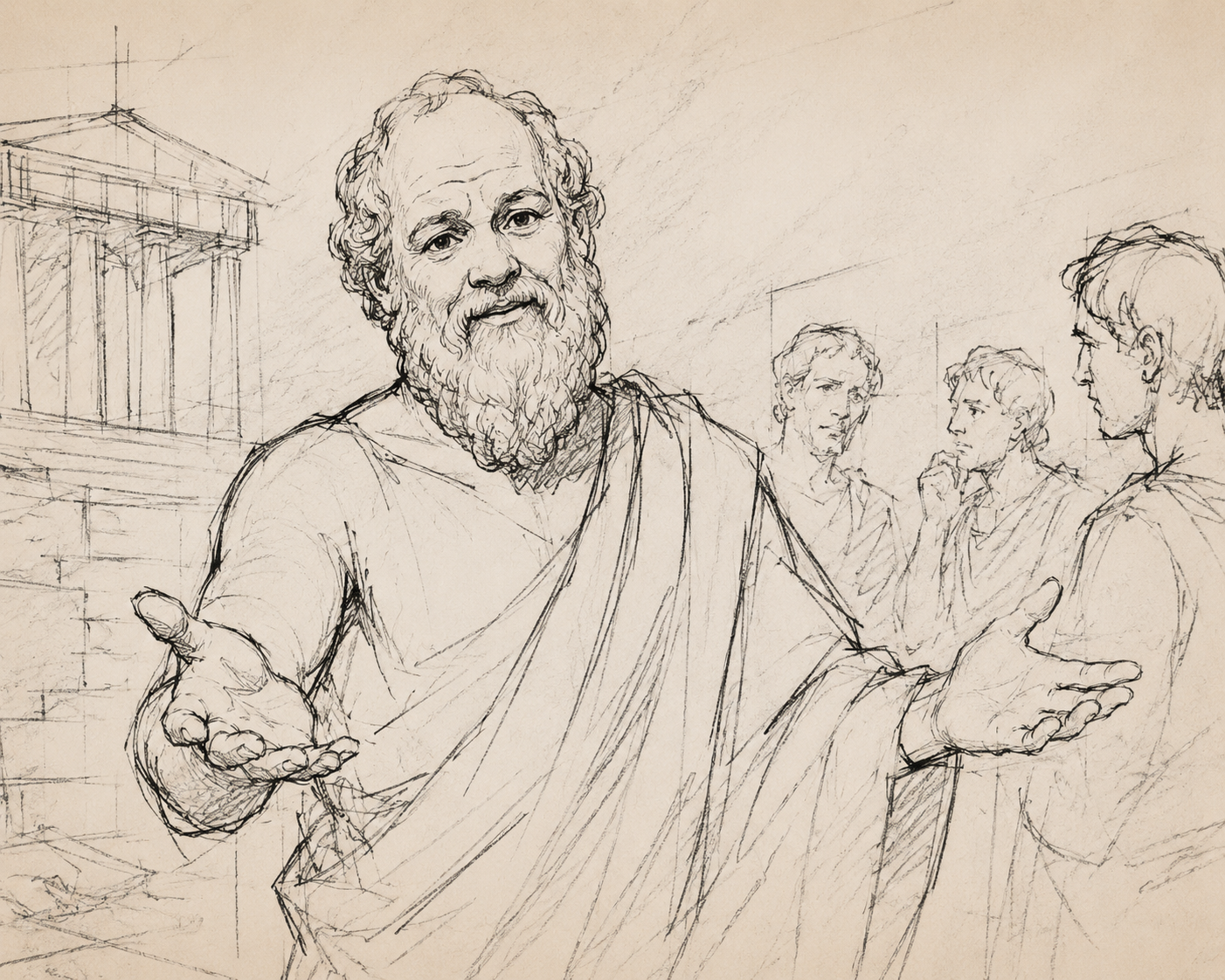
For Friedrich Nietzsche, Socrates represents a decisive turning point in Western history: the triumph of dialectic, rationalization, and moralization over the tragic wisdom of the Greeks. In Nietzsche’s telling, Socrates appears as a decadent figure unable to endure the chaos and ambiguity of life without subordinating it to reason. The Socratic demand that existence justify itself before thought becomes, for Nietzsche, the seed of metaphysics, morality, and ultimately nihilism. Against the expansive, overflowing energies of life, Socrates introduces a reflective and corrective consciousness that seeks to tame becoming into intelligibility.
Nietzsche’s critique depends upon a deeper anthropology. Human beings are, fundamentally, interpretive and creative animals: beings that represent the organization of a flux of drives, affects, and sensations in narratives, values, and worlds. Even truth is a kind of sublimated fiction. Greatness therefore lies in the expansive organization of life — in the artistic, affirmative, and overflowing transformation of existence. Socrates appears suspicious because he seems to turn away from this dangerous openness toward dialectical safety and rational self-justification.
Yet Martin Heidegger’s analysis of thrownness permits a striking reversal of Nietzsche’s interpretation. Heidegger argues that human beings do not first exist as isolated subjects1 constructing meaning out of sensory chaos. Dasein always already finds itself within a meaningful world it did not create: language, law, culture, craft, mortality, and history are inherited before they are chosen. Explanation itself presupposes this prior intelligibility. The craftsman does not invent the workshop-world within which hammering makes sense; the apprentice inherits practices, standards, tools, and purposes before mastery becomes possible. Even breakdown reveals this dependence: when the hammer breaks, it does not dissolve into atomized sensations, but becomes conspicuous against the background of a disrupted world of concern.
Thrownness therefore means that existence is radically indebted to a clearing of meaning that precedes individual mastery. Human beings project possibilities, but only from out of a world already underway. Authenticity is not sovereign self-creation, but resolutely taking ownership of one’s finite belonging to this inherited world.
Seen from this perspective, Socrates begins to appear differently. The historical Socrates of Plato’s dialogues does not flee his world, but radically owns it. He refuses exile in the Apology because he will not abandon philosophy; he refuses escape in the Crito because he will not betray the laws and polis that formed him. Even when Athens condemns him unjustly, Socrates distinguishes between the failures of particular Athenians and the legitimacy of the world to which he belongs. The laws gave him upbringing, education, citizenship, and the very space in which questioning became possible. To destroy them when they no longer serve him would be a denial of his indebtedness.
Thus Socrates’ acceptance of the hemlock can be understood not as weakness before life, but as a profound confrontation with thrown existence. Nietzsche sees in Socrates a flight from dangerous becoming into rational security. Heidegger’s recovery suggests the opposite: Socrates may exemplify a radical ownership of one’s finite situation without fleeing into fantasies of mastery, self-assertion, or metaphysical grounding. His freedom is not the autonomy of a detached subject, but an answerability to the world that sustains him.
In this light, Nietzsche’s own position becomes vulnerable to Heidegger’s critique of metaphysics. Though Nietzsche destroys stable substances and transcendent truths, he still interprets beings through an underlying ontology of force, drives, and will to power. The world remains explained through an ontic principle that is dynamic rather than static, but explanatory nonetheless. Heidegger argues that this still forgets the more primordial question of Being itself: the meaningful disclosure that makes all interpretation possible. Nietzsche sees the overflow of life, but Heidegger asks whether this overflow is itself granted by a clearing not of our own making.
The significance of Socrates after Nietzsche is therefore not the restoration of rationalism against tragedy, but the recovery of a more originary philosophical comportment: radical ownership joined to radical indebtedness. Socrates stands not as the enemy of life, but as one who accepts the finite world that has claimed him — its laws, friendships, obligations, and mortality — without evasion. If Nietzsche teaches us to overcome inherited idols, a Heideggerian retrieval of Socrates reminds us that even our greatest moments of creativity and joy arise from possibilities we did not create for ourselves and for which we owe a debt of gratitude.
- For Nietzsche, subjectivity is technically a fable about action. However, the Heideggerian critique reveals a latent subjectivism in his approach: Nietzsche relies on explanation over description, ultimately weakening his own perspectivism by positing an authoritative final explanatory account of human being as becoming. From a Heideggerian perspective, Nietzsche remains caught in the old metaphysical tendency to reify life through explanation, whereas simply letting Being be would allow more salutary ways through life to disclose themselves. ↩︎