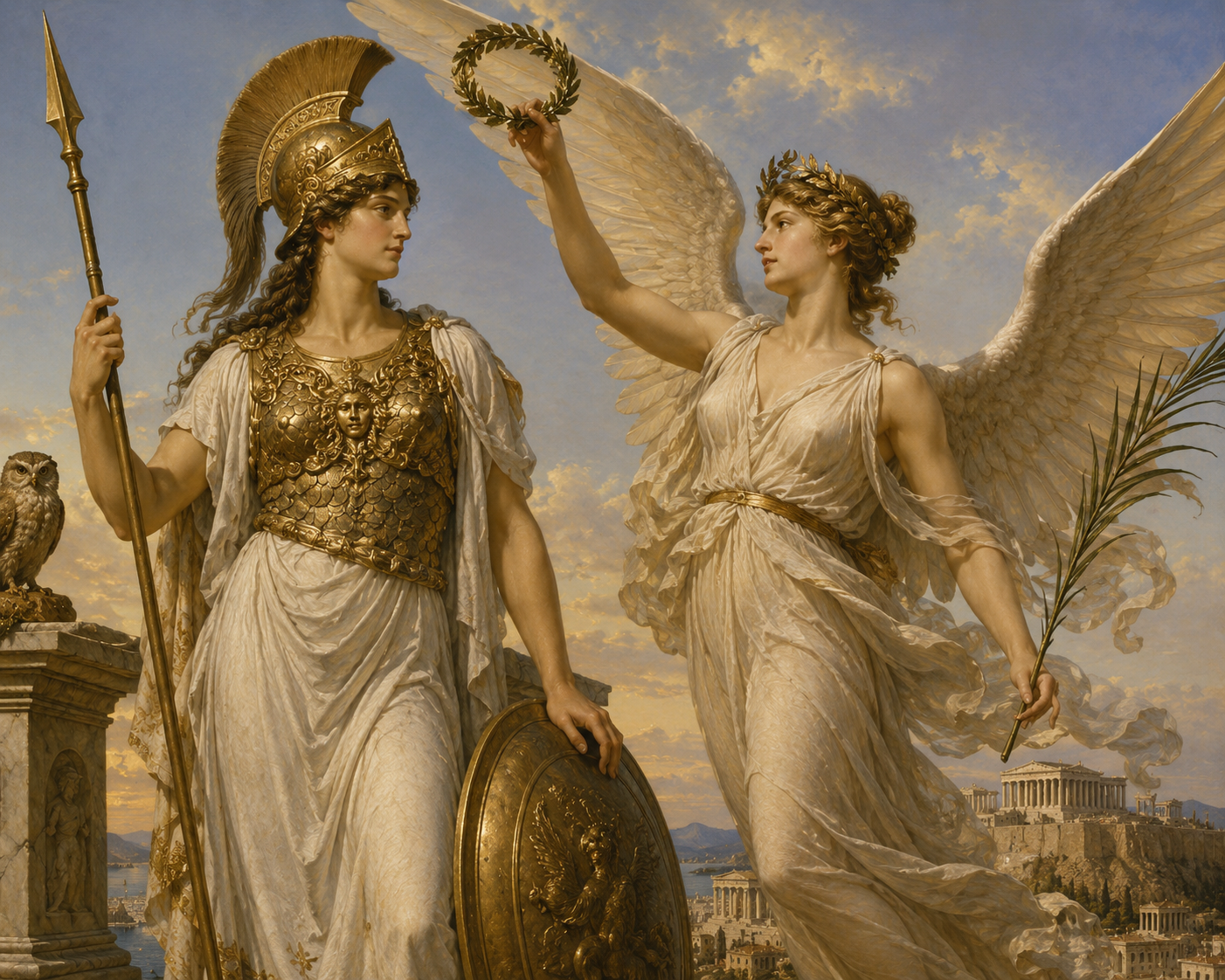
This is a short philosophical meditation on the effect of the rise of philosophy as a discipline on the psychosomatic world of the Archaic Greeks.
We say that Athena is the goddess of wisdom (sophia)—and in doing so, we accidentally name that by which she was killed. Sophia, a combination of mind and scientific knowledge—nous and episteme—is the dominant faculty of the god-destroying philosopher, armed with his own deconstructive fury. How could the goddess of wisdom be so foolish as to arm her enemies with the weapon of her undoing?
And yet Athena stands defiant in the face of this irony. We still discern her quiet power and dignity, even now, millennia after the fall of her city and the ruin of her temple. Why is this? Does she know something we don’t?
Perhaps a clue lies in that other, neglected form of wisdom: phronesis. If we remember our Aristotle, phronesis stands in contrast to episteme. Phronesis is nous’ housekeeper, concerned with practical matters and change within the realm of appearances. Episteme, by contrast, is nous’ proper mode of knowing, since it regards the unchanging. Sophia, the name for humanity’s highest virtue and happiness, is nous occupied with episteme.
Athena, however, seems unimpressed by this elevation of nous. She gestures all around us to make her point. We see the fire and madness of modernity and begin to take her clue: what is missing from our conception of sophia?
If we return to the curious case of phronesis, we find something revealing in its etymology. The word comes from phren—often pluralized as phrenes, meaning “chest”—and from phronein, “to be wise,” “to think”. To think, as it were, from the chest: from the lungs, the diaphragm, the heart.1
The Archaic Greeks did not yet have the terms episteme and phronesis; they had sophia, meaning “skill,” its adjective sophos, “skillful,” and phrenes, the thinking torso.2 Moreover, nous was not originally the sole organ of thought—the “mind” as we conceive it today—but one among several sites of understanding in the torso, alongside phrenes, thymos (spirited drive), and others.
To think through these bodily faculties—nous, phrenes, thymos—is said to be placing (or having placed) matters into them for consideration, through experience, feeling, and intuition. These are organs of thought, each with its own intelligence and activity. Thinking well (sophia) was not generalized thinking about thinking, as it later became for the philosophers. It was skill engendered by good digestion, requiring a suite of healthy organs, each performing its own particular job in harmony with the others.

Here, in this neighborhood of knowing organs, the goddess Athena grew up. She is the goddess of skill residing in the thinking chest, the patroness of heroes who are great of torso—strong in nous, phrenes, and thymos. It should not surprise us that the disruption of the delicate balance among these modes of knowing threw Athena’s world into disarray.
But how? Why should the mode of knowing belonging to nous—the organ of planning, intuition, and perception—when given its own term (episteme) and elevated above the rest, bring the fall of Athena’s world? Why does she belong to a harmonious chorus of phrenes, and why does she fall when nous becomes tyrant?
The answer is rather simple. The Archaic Greeks had not yet endured the great contest between Parmenides and Heraclitus over whether reality was eternal and unchanging or a flux of becoming. The nuanced theories that followed—especially those of Plato and Aristotle, who sought to reconcile these opposites—transformed the psycho-somatic landscape of the Greeks. Nous, the organ of planning and intuitive vision, was elevated to the position of knower of the unchanging (episteme), while the other organs of knowing were relegated to the mutable world (phronesis). The mind was uprooted from the torso and exiled to the head.
Without the organs of the heart—those which condition and temper its content—the intellect could form no proper idea (no notion, no style) of gods or goddesses, for such beings possess hearts that are changeable, like ours. The unchanging deities of the philosophers have met their match in modernity. Divine wisdom in the living sense proper to nous in its original role requires a heart that moves. In losing that heart, we lost Athena and sophia. And so humanity finds itself, once again, in need of reconstructing its psychosomatic world—before the void, now heartless and hungry for what it cannot have (the unchanging, the absolute), finds still more ways to ensnare us in the technological Gestell.

- Interestingly, the verb phronein often carried a communal connotation. In the Odyssey, the related idea appears as homophrosynē (“being of one mind”). The root may even be cognate with the English word phrase, further suggesting the close link between this ancient organ of thought and speech. ↩︎
- Nietzsche notes in PPP (trans. G. Whitlock, p. 8): “Etymologically, [sophos] is related to sapio—‘to taste’; sapiens—‘one who tastes’; and saphens—‘tasteable’. We still speak of ‘taste’ in the arts.” He goes on to distinguish this early sense of sophos from the later philosophical asceticism and voracious intellectualism, associating it instead with a kind of “sharp taste, a sharp knowledge, without any connotation of a faculty”. ↩︎
References
Holmes, J. B. (2012). Parsing the mind with Homer. Bridgewater Review, 31(2), 29–31.
Dedović, B. (2021). “Minds” in “Homer”: A quantitative psycholinguistic comparison of the Iliad and Odyssey. University of Maryland Press.
Nietzsche, F. (2020). Pre-Platonic Philosophers (G. Whitlock, Trans.). University of Illinois Press. (Original work published 1872)